Home › Learn › How to Set Scale on a Floor Plan Measurement Tool
How to Set Scale on a Floor Plan Measurement Tool
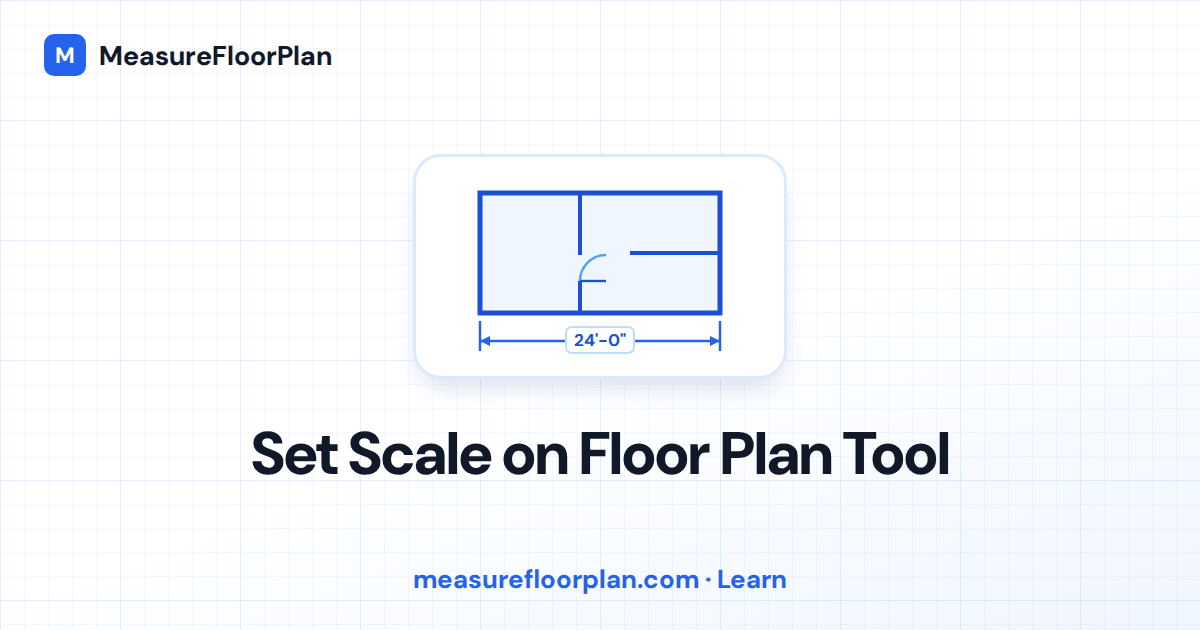
Setting scale is the most important step in measuring a floor plan. Get it right and every polygon you trace converts to accurate square footage. Get it wrong and every measurement is off by the same proportional error. This guide shows exactly how to do it and how to verify your calibration.
Measure Your Floor Plan in Minutes
Upload a plan, set the scale with one known wall, and measure anything: wall lengths, room areas, and total size. Try the free demo, then measure your own plan for $9. No signup required.
Upload Floor PlanHow scale setting works
When you trace a polygon the tool calculates its area in pixels. Without a scale reference, pixels have no real-world meaning. You provide the conversion by clicking two points along a wall where you know the real-world distance and entering that distance. The tool derives a pixels-per-foot ratio and applies it to all polygon areas automatically.
Step-by-step
1. Identify a wall or dimension on the plan where you know the real-world length. 2. Zoom in to that wall so you can see the endpoints clearly. 3. Click at the start of the known segment. 4. Click at the end of the known segment. 5. Enter the real-world length and press Enter. 6. All polygon areas update instantly based on the new calibration.
Best reference lengths to use
Longest labeled wall on the plan (best): A 40-foot exterior wall gives maximum accuracy. Total house width or depth if labeled: Often the most reliable reference. Room dimension labels: Use the longer of the two labeled room dimensions. Scale bar: Click its endpoints and enter the length it represents. Door width (last resort): Standard doors are 2'8" (32") or 3'0" (36"): works if that's all you have, but gives less accurate calibration than longer references.
Why longer reference = better accuracy
Calibration divides real-world length by pixel length. Any click error (say 3 pixels) is divided by total pixel length. For a 10-pixel reference: 3/10 = 30% error. For a 200-pixel reference: 3/200 = 1.5% error. The effect of click uncertainty drops dramatically as reference length grows.
Common mistakes
Using the printed scale notation on a resized image: "1/4" = 1'" is only accurate at the original print size. On a digital image calibrate from known dimensions, not the printed ratio. Interior vs exterior mismatch: If a labeled dimension spans exterior-to-exterior, click the exterior wall faces. Forgetting to recalibrate after uploading a new image: Scale is image-specific. Set it fresh on each uploaded floor.
Verifying your calibration
After setting scale, trace a room with a labeled size: "12 × 14" should return approximately 168 sq ft. If you get 145 or 190, recalibrate using a different (preferably longer) reference wall. A quick verification trace takes 30 seconds and gives you confidence before tracing the full floor plan.
Measure Your Floor Plan in Minutes
Upload a plan, set the scale with one known wall, and measure anything: wall lengths, room areas, and total size. Try the free demo, then measure your own plan for $9. No signup required.
Upload Floor PlanFrequently Asked Questions
How do I set the scale on a floor plan?
Find any wall on the plan with a labeled real-world dimension (a 12-foot bedroom wall, for example), trace those two endpoints in the measurement tool, and type the labeled length. The tool calibrates every other distance on the plan to match.
What's the best wall to use for setting scale?
The longest clearly labeled wall on the plan. Setting scale from a 40-foot exterior wall is far more accurate than from a 3-foot door, because any imprecision in your point placement is amplified by the inverse of the reference length.
What if my floor plan doesn't have any labeled dimensions?
Use a known fixed reference: standard interior door width (2 feet 8 inches or 3 feet), exterior door width (3 feet), refrigerator alcove (36 inches), or standard bathtub length (60 inches). Less precise than a labeled wall, but workable for rough estimates.
Can I use a graphic scale bar?
Yes. If the plan has a printed scale bar (a labeled segment showing 1 foot, 5 feet, etc), trace the scale bar in the tool and enter its labeled length. Graphic scale bars are usually more reliable than fixture-size estimates.
How do I know if my scale is set correctly?
Set scale from one labeled dimension, then check that a second known dimension on the plan reads correctly after calibration. If the two agree within 1 to 2 percent, scale is set right. If not, recheck your point placement on the original reference.